
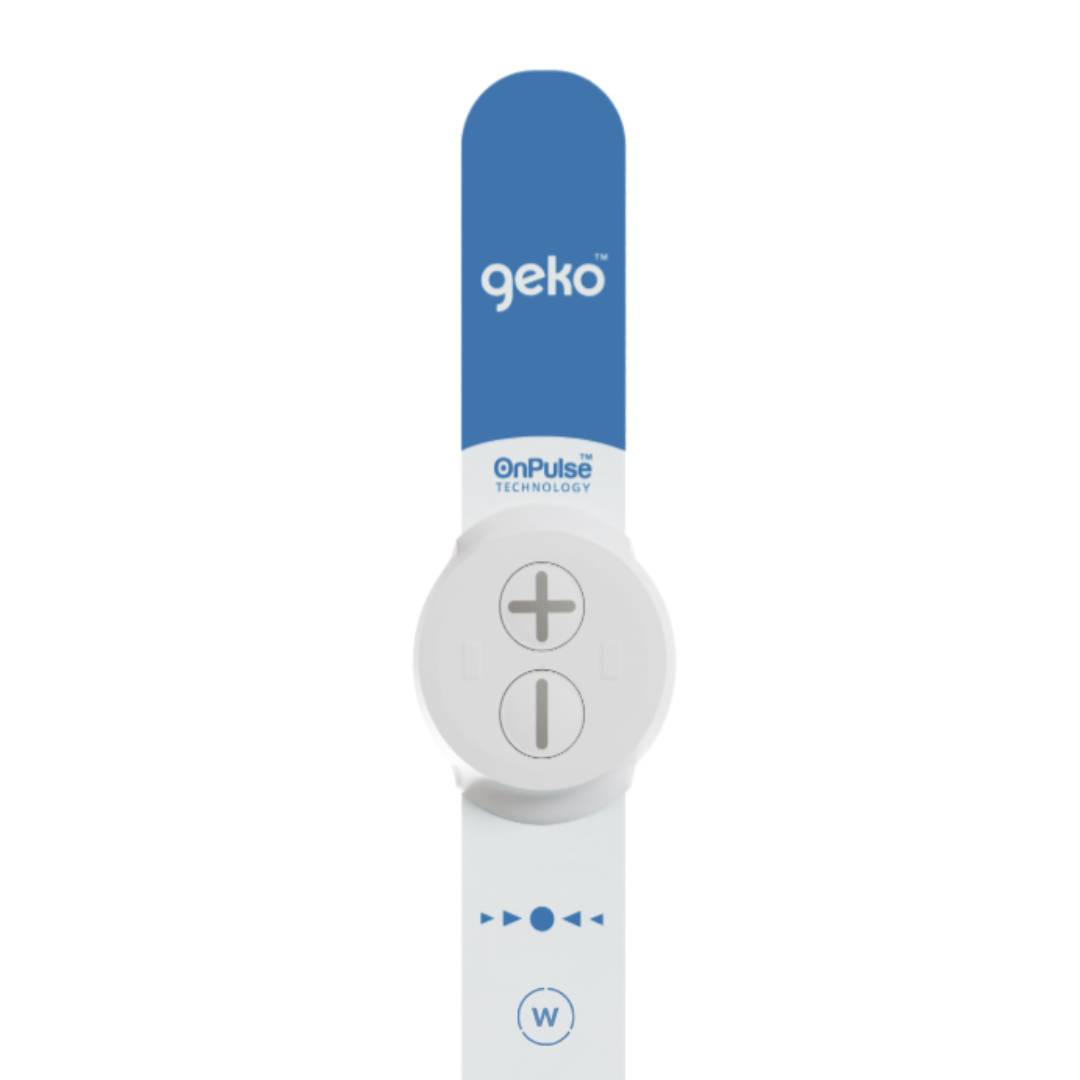
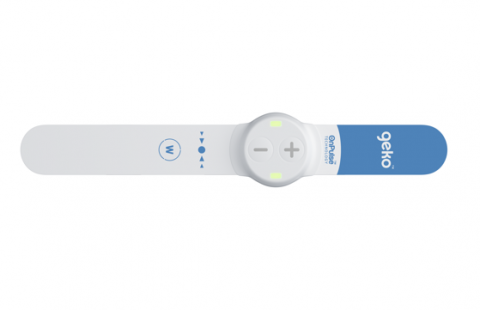


geko™ W3 Wound Therapy Device — Heal Chronic Leg Wounds
- Regular price
- $0.00
- Regular price
-
- Sale price
- $0.00
- Unit price
- per
Couldn't load pickup availability
When a wound stops healing.
Chronic leg wounds often stall for one reason: not enough blood is reaching them. The geko™ W3 is a small, self-adhesive device worn below the knee that activates the calf and foot muscle pumps, restoring circulation to the wound site alongside standard care.
How it works
Adjunctive wound therapy
The geko™ W3 is used alongside standard wound care to address three things that keep leg wounds from closing: poor circulation, lower limb oedema, and an inactive muscle pump. It does not replace your wound care plan. It works with it.
Simple to apply, no clinical fitting
Peel and place
Apply the self-adhesive device below the knee, over the common peroneal nerve. No wires, no gels and no fitting appointment required.
Gentle stimulation
Painless pulses activate the calf and foot muscle pumps, mimicking the circulatory effect of walking even in patients who can't move much.
Blood reaches the wound
Increased venous, arterial and microvascular flow carries oxygen and nutrients to the wound bed, and helps move fluid out of the surrounding tissue.
Features & Benefits
Three-electrode design
The W3 uses a three-electrode configuration built for comfort over extended wear, and is gentler on fragile or compromised skin than the T3.
12 hours on, 12 hours off
An intermittent protocol designed for wound therapy, giving the skin a rest period between applications.
Increases blood flow to the wound
Activating the calf and foot muscle pumps raises venous, arterial and microvascular flow, including in the wound bed itself.
Works with or without compression
Can be used alongside below-knee compression, or on its own where compression is contraindicated or can't be tolerated.
Home and outpatient use
No clinical setup, no wires and no charging, so it fits community wound care and home settings as easily as an outpatient clinic.
Drug-free
Works with the body's own muscle pumps. No medication, and no systemic side effects from the device itself.
Which wounds it's used for
The geko™ W3 is used across lower limb wounds where circulation is the limiting factor in healing.
Venous leg ulcers
The most studied application. Venous leg ulcers stall when the calf muscle pump isn't working well enough to clear blood from the lower limb. Compression addresses part of that problem; activating the muscle pump addresses another part. The two are used together.
Diabetic foot wounds
Diabetic foot ulcers frequently involve both nerve damage and reduced blood supply. Imaging research has shown increased microvascular flow in the wound bed of diabetic foot ulcers, across both neuropathic and neuroischaemic presentations.
Mixed aetiology and arterial wounds
Wounds with both venous and arterial causes are among the hardest to manage, because full compression is often unsafe. Increasing arterial and microcirculatory flow gives an option where compression alone isn't appropriate.
Lower limb oedema
Swelling around a wound raises pressure in the tissue and slows healing. Activating the muscle pump helps move that trapped fluid back into circulation, reducing the oedema that keeps the wound environment inflamed.
When it's usually introduced
The geko™ W3 is typically added when a wound isn't progressing on standard care alone, or when compression isn't an option. Common triggers include:
- A wound has reduced by less than 30% after four weeks of care
- Compression can't be tolerated or is contraindicated
- The patient has a fixed ankle joint or poor ankle flexion
- The patient is largely immobile, so the muscle pump isn't being activated naturally
- Lower limb oedema is persisting despite standard management
- The wound is long-standing and has stalled at a plateau
See how it works
Watch how a small pulse below the knee sets the calf and foot muscle pumps to work, moving blood toward the wound the way a natural walk does.
geko™ in action
More short videos on how the geko™ works and the conditions it helps.
The clinical evidence
The geko™ device has been studied in randomised trials, case series and imaging studies covering venous leg ulcers, diabetic foot wounds and wound bed circulation. Below are the headline findings, then every study behind them.
the rate of wound healing over four weeks, when added to compression therapy
Measured in a randomised within-patient controlled trial of 60 patients with hard-to-heal venous leg ulcers. Bull et al., International Wound Journal, 2023.
modelled saving per patient over 12 months in a UK NHS setting
From a separate health economic model built on 51 patients from the trial above, which also projected a 68% increase in healing probability. Tuson et al., International Wound Journal, 2024. Modelled figures, not measured outcomes. NZD shown at approximately 2.30 GBP/NZD, July 2026 — and because these are UK NHS unit costs, the converted figure is indicative only, not a projection of New Zealand savings.
How to read this section. Each study lists its design and the patients it was run in, because that context changes what the result means. A randomised trial and a case series are both useful evidence and they carry different weight. Where a study has an important limitation, we've said so. Every entry links to the published source so you can read it yourself.
Wound healing outcomes
International Wound Journal · 2023
The impact of a new intervention for venous leg ulcers: a within-patient controlled trial
The impact of a new intervention for venous leg ulcers: a within-patient controlled trial
- Adding neuromuscular stimulation to multi-layer compression produced a statistically significant two-fold increase in the rate of wound healing over four weeks, compared with compression alone
- Each patient acted as their own control, which removes the variation between patients that makes leg ulcer trials so difficult to run
- Endpoints were rate of wound margin advance and percentage area reduction over four weeks
- The authors chose those endpoints deliberately: trials using complete healing as the endpoint are rarely large enough to detect a real effect. This measures how fast wounds closed, not how many closed completely.
British Journal of Nursing · 2018
Case series: the geko™ device on lower limb wounds of differing aetiology
Case series: the geko™ device on lower limb wounds of differing aetiology
- Mean wound surface area decreased by 7.6 cm²
- Mean proportion of granulation tissue in the wound bed increased by 21%
- Pain levels reduced in 52% of patients who completed the study
- Two patients (8%) achieved complete wound closure within the eight weeks
- Effect on swelling was hard to isolate because 76% of the group were also receiving compression therapy.
International Wound Journal · 2017
Evaluation of a muscle pump-activating device for non-healing venous leg ulcers
Evaluation of a muscle pump-activating device for non-healing venous leg ulcers
- Assessed the device in wounds that had failed to progress under standard care
- Part of the earlier evidence base that led to the 2023 randomised trial
- A companion paper by the same group evaluated refractory ulcers specifically
Why it works — blood flow to the wound bed
Journal of Wound Care · 2021
Microcirculatory changes in venous leg ulcers using peroneal nerve stimulation
Microcirculatory changes in venous leg ulcers using peroneal nerve stimulation
- Directly imaged and measured blood flow in the wound bed and the skin around it
- Compared flow with the device switched on against switched off, in the same patients
- Microcirculation in the wound bed is what delivers oxygen to healing tissue
International Journal of Lower Extremity Wounds · 2025
Increased microvascular flux in the wound bed of diabetic foot ulcers
Increased microvascular flux in the wound bed of diabetic foot ulcers
- The microcirculatory benefit seen in other wound types also occurred in diabetic foot ulcers
- Held across both neuropathic and neuroischaemic patients
- Device was safe to use in this population
Advances in Skin & Wound Care · 2025
Increased microcirculatory flux in mixed aetiology leg ulcers
Increased microcirculatory flux in mixed aetiology leg ulcers
- Extends the microcirculation findings to wounds with combined venous and arterial causes
- Mixed aetiology ulcers are among the hardest to treat with compression alone
International Angiology · 2016
Measurement of blood flow in the deep veins of the lower limb using the geko™ device
Measurement of blood flow in the deep veins of the lower limb using the geko™ device
- Statistically significant increases in both blood flow volume and velocity
- Measured in the gastrocnemius, peroneal and posterior tibial veins
- Establishes the underlying circulatory effect the wound healing research builds on
Cost impact and clinical consensus
International Wound Journal · 2024
Cost-effectiveness analysis in UK healthcare settings
Cost-effectiveness analysis in UK healthcare settings
- Modelled a 68% increase in healing probability versus standard care alone
- Modelled cost saving of £774.14 per patient across a 12-month period
- Savings came largely from fewer nurse visits and reduced dressing use
- This is an economic model, not a clinical trial. The 68% is a modelled probability, and the costings are UK NHS figures with no direct read-across to New Zealand.
International Wound Journal · 2024
Position paper: continuous muscle pump activation in venous leg ulcer treatment
Position paper: continuous muscle pump activation in venous leg ulcer treatment
- Reviews where neuromuscular stimulation fits alongside compression therapy
- Particularly relevant for patients who cannot tolerate compression
- A good starting point if you want an overview rather than individual trials
A note on how this research was funded
Much of the published research on the geko™ device was funded or sponsored by the manufacturer, Firstkind Ltd, and Professor Keith Harding is an author on several of these papers as well as editor of the International Wound Journal. That is common in medical device research and does not invalidate the findings, but it is worth knowing when you read them. We have linked to sources rather than summarising selectively so you can judge the evidence for yourself.
geko™ W3 or geko™ T3?
Two devices, two different jobs. The W3 is built for wound care on fragile skin; the T3 supports circulation, recovery and clot prevention. Here's how to tell them apart.
geko™ W3
Wound therapy
- Wound care and healing support
- Three-electrode design
- Intermittent use — 12 hours on, 12 off
- Gentler for fragile skin
- Used alongside a wound care plan
geko™ T3
Circulation, recovery & prevention
- Injury recovery
- Oedema (swelling) reduction
- DVT / blood-clot prevention
- Designed for continuous use
Not sure which is right for your patient or situation? Get in touch with our team — we can advise on suitability and provide clinical documentation.
Frequently asked questions
What is the geko™ W3 and how does it work?
The geko™ W3 is a small, self-adhesive medical device applied below the knee, over the common peroneal nerve. It delivers a gentle electrical pulse roughly once a second, activating the calf and foot muscle pumps. That increases venous, arterial and microvascular blood flow in the lower limb, including in the wound bed.
Why won't my leg wound heal?
Chronic lower limb wounds often stall because not enough blood is reaching the tissue. Without adequate circulation the wound bed doesn't get the oxygen and nutrients it needs to repair. Reduced mobility, poor ankle movement, venous insufficiency and lower limb swelling all contribute. Addressing circulation is one part of a wound care plan alongside dressings, compression and treating the underlying cause.
Does it replace compression therapy?
No. The geko™ W3 is adjunctive, meaning it's used alongside standard care rather than instead of it. It can be worn with below-knee compression. It can also be used on its own where compression is contraindicated or can't be tolerated, which is one of the main reasons it gets introduced.
How long is it worn for?
The W3 uses an intermittent protocol of 12 hours on and 12 hours off. Always follow the Instructions for Use supplied with the device and the guidance of the wound care clinician managing the wound.
Does it hurt?
No. The stimulation is gentle. At the right setting you'll feel a light pulsing and see a small upward movement of the foot. The level is adjustable so it can be set to something comfortable.
What's the difference between the W3 and the T3?
The W3 is designed for wound therapy. It has a three-electrode configuration, runs an intermittent 12 on / 12 off protocol, and is gentler on fragile skin. The T3 supports circulation, recovery, oedema reduction and DVT prevention, and is designed for continuous use. See the comparison above.
What is the clinical evidence behind it?
The geko™ device has been studied in a randomised trial in hard-to-heal venous leg ulcers, several case series, imaging studies of wound bed circulation, and a health economic analysis. You can read the studies, including their limitations, in the clinical evidence section above, or browse our full research library.
Is it safe? Are there any side effects?
The geko™ W3 is a registered medical device. As with any medical device there are conditions where it may not be suitable. Always read the Instructions for Use, and speak with the clinician managing the wound before starting.
How do patients get one?
If a patient is interested in purchasing the geko™ W3, OneUp will work with them alongside their district wound nurse to apply, manage, and confirm that the product is appropriate for their situation. We supply to wound care clinics, hospitals, GPs and directly to patients across New Zealand.
Talk to us about the geko™ W3
Not sure whether the W3 is right for a particular wound? We can advise on suitability, provide clinical documentation, and arrange supply anywhere in New Zealand.
Order onlineThe geko™ W3 is a registered medical device intended to increase blood circulation, promote wound healing, and treat and prevent oedema. It is an adjunctive therapy used alongside standard wound care, not a replacement for it. Always read the Instructions for Use. If you have a wound or a medical condition, speak with your healthcare professional about whether the geko™ W3 is appropriate for you.
